
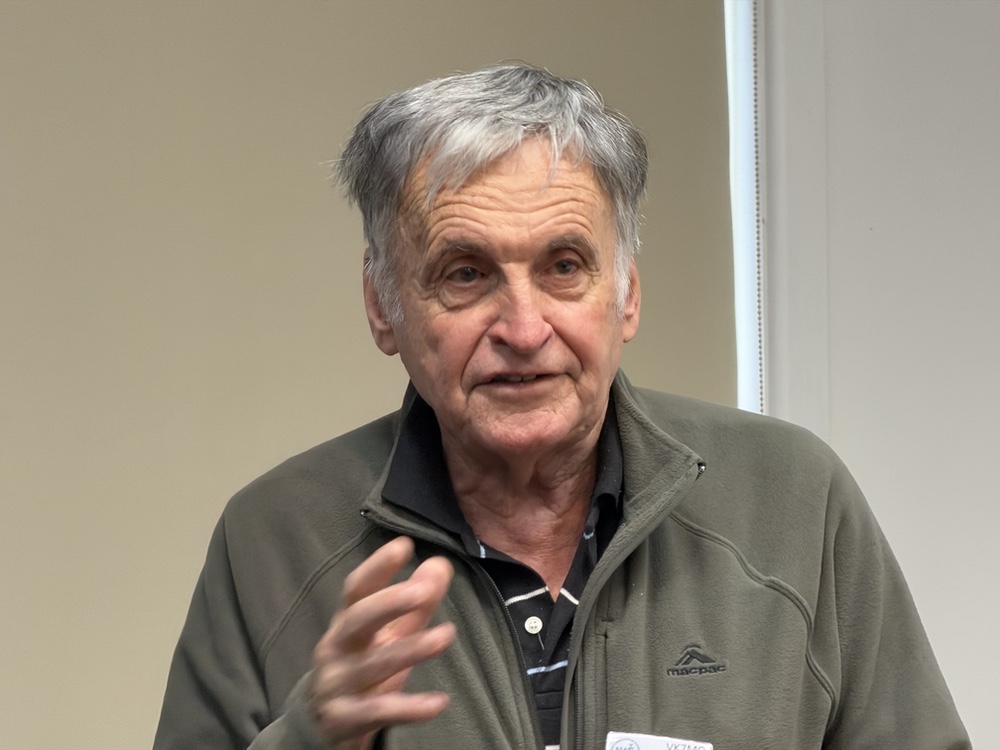
Rex Moncur, VK7MO, came to the Macedon Radio club talk with a result from only a few days earlier. Using near-infrared LEDs, a telescope-style receiver and a lot of patience, he and a fellow ham had decoded signals across Bass Strait by bouncing light off high clouds.
The speaker
Peter Wolfenden, VK3RV, introduced Rex. They first met on 2 metres in the mid-1960s, having both been licensed in the early 1960s, and later worked each other on 70 centimetres. Peter recalled being amazed at Rex’s homebrew valve transmitter, a big triple-final stage driven by another valve stage. Rex went on to work as an engineer at the Bureau of Meteorology and then at the Antarctic Division, where he was Director.
Rex said he was in Victoria for a family visit and for two radio reasons. One was to compare notes with Peter on amateur radio history. Rex has his late father’s papers (his father was VK3LN), which describe a clandestine post-war network in which amateurs were issued military 522 sets as a backup communications system in case the PMG was compromised. He plans to write it up for Amateur Radio magazine. The other reason was optical DX.
The idea: a cloud as a mirror
Rex’s project runs on 730 nanometres, in the near infrared, using LEDs as the transmitter. This part of the spectrum isn’t regulated by the ACMA. He compared it to the early days of six metres in 1936, when a whole new area of ham radio was opening up.
To get past the curvature of the earth, the signal is aimed at high cloud and scattered back down to a receiver far away. That creates a tricky requirement. You need high cloud to scatter the light but no low cloud between you and it, and you have to operate in the dark because the sun is a huge interference source. Rex had spent about three weeks in Victoria without finding a suitable night.
Last Thursday’s contact
Conditions looked promising, so Rex left the old-timers’ luncheon early and drove toward Foster. The site he’d picked had become overgrown with trees, and low cloud was in the way. He moved to Bass Hill, helped by VK3MAP, who reported on the low cloud from a sunnier location. Across the strait, Justin, VK7TW, was set up at Mount Barrow in Tasmania.
Once it was dark, Rex transmitted a single tone at 1420 Hz. A single tone can’t carry information, but it puts all the energy on one frequency, so it’s the best way to check whether anything is getting through. Justin used one-minute integration in Spectrum Lab, effectively a bandwidth of about 0.01 Hz. After a minute he reported a very weak signal on the right tone.
They then switched to modulation using FST4, a WSJT-X mode. In five minutes it sends two callsigns and a grid locator, which is 77 bits, and it can theoretically decode down to about -35 dB. Rex noted this is a far lower data rate than the high-speed system in the previous talk. The results were:
- Five-minute transmit: decode at -33 dB, only 2 dB above the limit.
- Second attempt, ten minutes later: another decode at -33 dB.
- Third attempt: -34 dB. The signal had been varying, probably because the beam was still passing through patchy low cloud, and the mode’s forward error correction copes with gaps like that.
After that, things fell apart. They discovered a misunderstanding: Justin had been pointing at 0 degrees, while the calculations called for about 2 degrees of elevation. When he corrected it, nothing came through, and going back to 0 degrees also gave nothing. The low cloud at Rex’s end had probably become solid by then. Rex thinks that with both ends at 2 degrees from the start, the signals would have been stronger. His conclusion was that 357 km is achievable at 730 nm and that more is possible.
The hardware
Questions from the audience brought out the equipment details.
Transmitter. Rex uses a 93-watt LED array fed with roughly 270 watts, so the electrical efficiency is low. His earlier design used about 60 small reading-type Fresnel lenses, but they were hard to align and he suspected they weren’t illuminating properly. This time he used a single commercial torch-type lens with a narrow five-degree spot. The transmit beamwidth is about plus or minus 2.5 degrees.
Receiver. A 400 x 400 mm Fresnel lens focuses light onto a 10 x 10 mm avalanche photodiode, the biggest he can get. Cloud-scattered light is diffuse rather than a point source, so a larger detector area helps. The receive beamwidth is about plus or minus 1 degree.
A quirk of optics. A light detector responds to current, not power, so a 3 dB drop in signal power costs 6 dB at the output. When he and Justin started this work about 15 years ago, they doubled the transmitter power and got a 6 dB improvement, which surprised them both.
Cooling. Asked about cooling the receiver, Rex said he had tried Peltier coolers but the lens fogs up, so it’s easier to add more LEDs.
Pointing accuracy
Because the signal comes and goes with the clouds, Rex can’t peak up the antenna by watching signal strength. Azimuth and elevation have to be right from the start. For that he uses a compact GPS-based device, developed partly because of the war in Ukraine, that takes two GPS antennas and measures bearing and elevation. On a baseline of about four metres it gets around 0.03 degrees RMS error. He calibrated a rifle scope against another ham across the river in Hobart, then mounted a GPS antenna on it. Cloud height forecasts come from windy.com, which uses Bureau of Meteorology data, and from those he calculates the elevation angle and waits for cloud to appear at the right height.
Why FST4?
FST4 was designed for low frequencies and is the most sensitive mode in the WSJT suite, though it’s poor with Doppler shift and spread. Rex sidesteps that because he transmits at baseband, a 1420 Hz tone, so cloud movement doesn’t produce Doppler. FST4’s four tones are only about half a hertz apart, so the whole signal fits in roughly 2 Hz, which is useful because of interference. 50 Hz mains lighting produces harmonics, and so do the large outdoor video signs, which flicker at 60 Hz. He chose 1420 Hz because it falls between both sets of harmonics.
Takeaway
Rex said he felt too old to keep up with the high-tech world of the previous speaker, but his work on optical scatter is just as inventive. The project mixes atmospheric physics, careful optics, weak-signal digital modes and some good luck with weather. In his words, it is creating a lot of joy for him.