
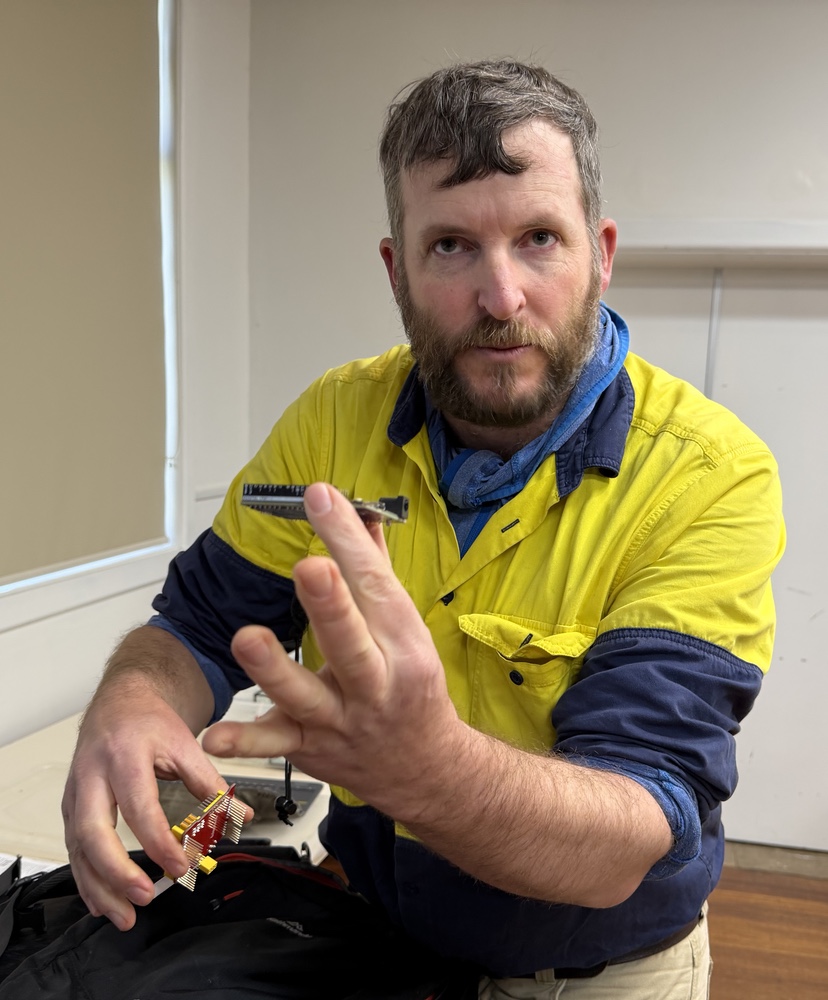
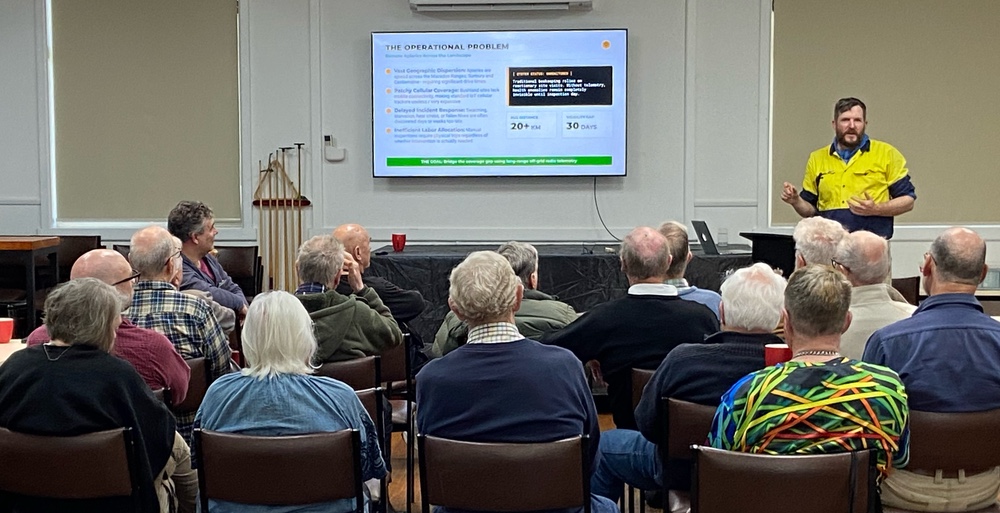
A fantastic talk at today’s meeting in Woodend. Mark from Mount Macedon Honey addressed the club. Here is a summary of his excellent presentation:
Beekeeping has hardly changed in 250 years. You drive out to an apiary, open the hives, find that everything is fine, and realise you’ve burned half a day and a tank of fuel on a hive that didn’t need you. Mark Bichan talked to our club about trying to change that. His goal is a low-cost network that lets him manage his apiaries from home, using LoRa radio, cheap microcontrollers and a lot of trial and error with real bees.
The problem: flying blind between visits
His apiary sites are about 20 kilometres apart. At best he gets a look at each one every 30 days, and during swarming season or a honey flow that shrinks to about 14 days. Many of those visits end with him opening hives and doing nothing. Commercial monitoring systems exist, but the sensors are proprietary and often locked to a vendor’s own software. The real killer is backhaul, meaning the cost of getting the data off-site. Satellite units run around $500 each plus annual fees, which is too much even for large commercial operators.
What a hive can tell you
A colony generates far more information than we can easily read. The talk focused on three signals:
- Temperature and humidity. Bees hold the brood nest at about 34.5°C, and a drift of a degree either way is a warning sign. A single sensor the size of a thumbnail covers both measurements. Temperature alone means little, but combined with season and other readings it becomes useful. A cool super suggests no bees are up there, while a super sitting around 28°C with humidity above 60% for about two weeks suggests nectar is being turned into honey and capped honey should be ready.
- Vibration. Every colony has its own characteristic pitch, much like a human voice, so fixed alarm thresholds tell you nothing. The system has to learn each hive’s normal frequency and then flag deviations of roughly 5–10%. Colonies also change pitch together, for instance when they lose a queen or sense a predator. He has moved from microphones to accelerometers fixed to the timber, which give a cleaner reading.
- Weight. Weight is the classic beekeeper’s signal, since it shows when to add supers or harvest. But load cells are expensive and finicky, and they read falsely if a hive isn’t perfectly level. Weight is what keeps him from his target of $45 per hive, and he thinks that price is 5–10 years away. In the meantime, temperature and humidity can stand in for it.
Nature fights back
The hardest problems weren’t electronic. Early prototypes were hardwired, and wires got torn out every time a hive was opened, so the team moved to Bluetooth. Then the bees themselves got in the way. Some colonies seal any gap under about six millimetres with propolis, which dampens the sensors. If a sensor sits on the frames, the bees build brace comb over it. He is still working on a fix, possibly recessing accelerometers into the timber behind an insect mesh.
There were other surprises. Line of sight matters more than expected across the ranges, and omnidirectional antennas weren’t enough, so some sites need targeted longer shots or relays. During last summer’s heatwaves the bees couldn’t keep the brood nest at 34.5°C inside thin wooden hives, which have very little insulation, and the colonies suffered. That’s pushing him toward better-insulated hive designs. Cockatoos love to rip out the rubber grommets that seal antenna holes, which lets moisture into the electronics.
The architecture
The system has four layers:
- Hive nodes. Small sensors measuring temperature, humidity and vibration, powered by a LiPo battery and a small solar panel, talking over low-power Bluetooth. Pairing gives a simple pass or fail, so nothing wastes power hunting for a connection.
- Apiary aggregator. An Arduino-class board with a LoRa module (about $30) that wakes shortly before the sensors do, collects their readings and sends them on. It also reports any hive it has lost contact with.
- LoRa backhaul. Packets are tiny, under 24 bytes, on unlicensed spectrum that almost nobody else uses, so congestion and dropped packets aren’t a concern. Range tests with small stubby antennas have given clear signals at about 35 kilometres line of sight. Syncs happen roughly every 30 minutes, with sleep cycles to save power.
- Home server. A repurposed 2008 MacBook running Linux with a basic dashboard. The plan is to move to the cloud with mobile alerts, and eventually to do edge computing at the apiary so it alerts only by exception, like a software beekeeper watching the hives.
He deliberately avoided Meshtastic, Meshcore, LoRaWAN community networks and crypto-incentivised gateways. Some rely on proprietary protocols or on someone else’s gateway coverage, which is thin in his area. Running his own LoRa network with cheap relays that are almost consumable means no fees, no maintenance contracts and no dependence on anyone else’s infrastructure. He’s relaxed about security too: if someone hacks it and reports the wrong temperature, the risk is low.
Why it matters
The aim is simple: stop visiting apiaries that don’t need him, and when he does visit, open two hives instead of twenty. That saves fuel and time, and it’s better for the bees, since colonies left undisturbed tend to be more productive. Other benefits he pointed to:
- Varroa mite. Varroa costs him about $75 per hive per year in treatments and monitoring. If vibration signatures can flag which colonies actually have high mite loads, he can treat 30 hives instead of 100, which means fewer chemicals and a better bottom line. Researchers in Canberra are looking at the link between acoustic signals and mite load.
- Pollination. Australia faces a predicted shortfall of around 290,000 colonies at peak pollination, pushing prices up. Sensor data could let beekeepers show growers that the hives they’re paying for are alive, building up and working.
- Breeding. If good breeder colonies share a frequency band, vibration might help identify promising colonies genetically, though nobody has looked yet.
- Theft. Hive theft is a real problem, and a monitoring network could act as a tripwire.
A live demo, and a call to the radio community
To close, he wiped two Arduino boards and used ChatGPT to generate the transmit and receive code. He uploaded it, pasted an error back into the chat when a serial port was wrong, and had the boards exchanging LoRa packets within minutes. He isn’t a software engineer, and he said his eight- and ten-year-old kids have had a go at programming these prototypes too. His pitch to the radio club was that LoRa plus AI makes projects like this accessible. You could build an IR sensor that alerts you at your house two and a half kilometres away and runs for five years for less than an off-the-shelf mains-powered product.
Mark’s broader message was to talk to people. Radio operators and beekeepers each know things the other doesn’t, and the useful ideas usually turn up only when you ask.