
A report on Heath VK3TWO’s presentation to the Macedon Ranges Amateur Radio Club
If you’ve ever wondered why so many hams are suddenly talking about little $30 boards, solar garden lights and a map of Victoria lit up with blinking packets, Heath VK3TWO’s talk to the Macedon Ranges Amateur Radio Club was the explanation. Heath took us through LoRa, the MeshCore network that has spread across the state in the past year, and LoRa APRS — and finished with a challenge to clubs about where new amateurs are going to come from.
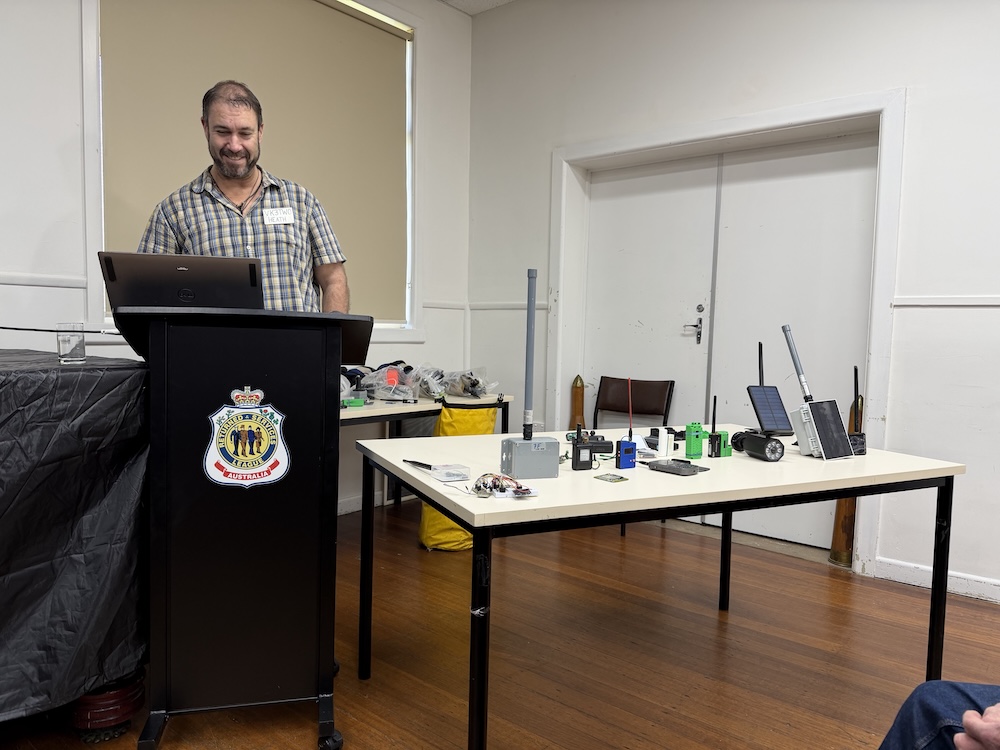
A speaker with some pedigree
Heath has held VK3TWO for more than 30 years, since he was 16. He joined the Army at 19 and served a decade, first as a military radio technician and then for most of his service in special forces, with multiple deployments to the Middle East. Since then he’s completed a double degree in computer science and a masters in engineering focused on communication systems, and worked across mining and offshore oil and gas on everything from digital radio and telemetry to microwave, satellite and emergency warning systems.
On air, he holds the QRP record in the RD Contest — taking it from the previous holder, his former XYL. These days microwave is his main interest, but since late last year he’s been, in his words, obsessed with MeshCore. His current party piece is a 411 km link from his home to Tasmania on 915 MHz.
LoRa in a nutshell
LoRa (short for “long range”) was designed for low-power telemetry and remote control in agriculture and industry. Like FT8 and JS8Call, it works below the noise floor, which is how modest hardware covers big distances. Rather than shifting between single tones, LoRa uses a sweeping “chirp”, and three settings govern its behaviour: spreading factor, bandwidth and coding rate. Forward error correction adds further robustness.
Most modules run around 150 mW (22 dBm). One-watt modules have become popular, though Heath rarely runs them at full power — their real advantage is a built-in LNA of around 8 dB, and on some versions a SAW filter. That filter matters: 915 MHz sits close to mobile phone bands, and some users near carrier towers (Optus being the worst offender) struggle with interference. His rule of thumb is that if your noise floor is above about −95 dBm, a SAW filter is worth having. A plain preamp, by contrast, can make things worse.
In Australia 915 MHz is ISM spectrum, not an amateur band, with a 1 W EIRP limit — something worth remembering before pairing a 1 W module with a high-gain antenna. There are also 433 MHz modules that reach into the 70 cm band, where amateurs can use full power, though encrypted systems like MeshCore aren’t permitted there. Even so, a large share of people on the 915 MHz networks are hams.
The ranges are impressive. Line-of-sight links of 80–100 km are common, 150 km and beyond happens regularly, and the Tasmanian path depends on tropospheric ducting — occasional in winter, but fairly reliable through the warmer months.
The hardware
A big part of LoRa’s appeal is cost. A Heltec V3 or V4 board will get you on air for about $30, and DIY “Faketec” builds come in cheaper still. Heath passed around a range of examples:
- A typical solar repeater build, costing roughly $75–100 in parts, versus $150–250 pre-built
- A $16 fake CCTV camera from Bunnings, gutted and fitted with a node and antenna for about $30 all up
- A “garden-peater” — a solar garden light sold with the node inside, around $60
- A Heltec tracker with built-in GPS, about $40, which doubles as an APRS tracker
- The Seeed Studio L1, which has one of the best reputations around, and the Seeed M1, chosen for its low-power nRF chip rather than the more common ESP32
Most nodes are driven from a phone app over Bluetooth, with no internet involved. Standalone units with their own keypad and screen exist for those who’d rather save their phone battery, but Heath admitted he regrets buying one — the phone app is simply easier and more capable.
LoRa APRS
The same boards can run firmware by CA2RXU that turns them into APRS trackers or iGates. Heath runs an iGate at home and regularly hears trackers up to 100 km away; between him and another ham near Healesville, most of Melbourne is covered. Australia still has relatively few iGates compared with Europe and the US, so more are welcome. Suggested uses include high-altitude balloons and letting family follow your movements on SOTA and POTA activations.
What MeshCore is
MeshCore grew out of New Zealand after the earthquakes there knocked out communications, with NZ ham Liam Cottle a key developer. Its defining philosophy is that the network is pure RF — no internet bridging — because a network relying on the internet loses half its coverage exactly when it’s needed. Most repeaters are solar powered and can run for a week on battery alone.
Compared with Meshtastic, which was once well populated around Melbourne but became unreliable as it grew, MeshCore separates roles. In Meshtastic every node repeats, with a limit of seven hops. In MeshCore, companion nodes talk only to repeaters, which form the backbone, and messages can travel up to 64 hops. Routing sorts itself out dynamically, though paths can be set manually. Nodes can also act as “room servers”, much like a packet BBS.
The result is a network stretching roughly 1,200 km from south-west Victoria to north of Newcastle — something Australia achieved before most of the world had more than local clusters. A new regions feature now segments traffic (AU, AU-VIC and subregions) to keep things manageable without cutting off long-distance contacts.
Users can send direct messages, much like SMS, or join channels: Public, ham radio, Bendigo, Ballarat, emergency and plenty more. Hashtag channels are public; others can be private and encrypted, such as the one Heath set up for the Bendigo club. During the Mount Alexander fires, a volunteer piped official emergency warnings into the emergency channel so they would still reach people if phones and internet failed — a community effort, not something to depend on, but a glimpse of the potential.
Beyond messaging, MeshCore handles telemetry, weather stations and remote control. MQTT gateways feed a live map of network traffic — complete with sound effects, which some enthusiasts keep running on a dedicated screen.
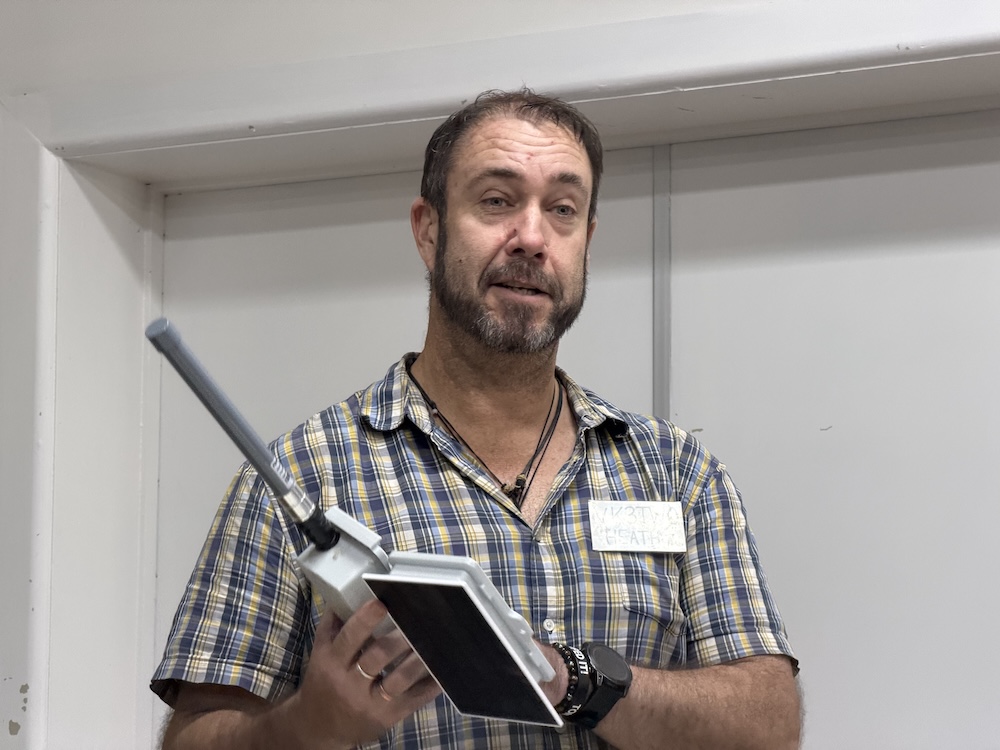
Planning tools
Heath’s favourite part of the web client is the tools section. The coverage tool takes a proposed site, pulls elevation data and predicts coverage — conservatively, in his experience. It’s how much of Victoria’s backbone was planned: put a repeater on one hill, look for the next blip on the coverage map, repeat. It also showed the Tasmanian group they needed only three repeaters to link north and south. A line-of-sight tool shows the terrain profile and Fresnel zone, and there are tools for discovering nearby nodes, logging noise floor and tracing paths.
A call to clubs
Heath’s main message was that this may be the best recruiting tool amateur radio has had in years. MeshCore draws people interested in electronics, programming and radio who have never encountered the hobby. Many users set their callsign as their node name, so newcomers constantly see callsigns and start asking questions — and the hams on the network have earned a reputation for helping with antennas and siting.
So his ask is simple: if you have a tower, a roof or access to a hill, put up a repeater. It’s cheap, it’s a good technical project, and it’s a community service even if you rarely send a message yourself. For clubs, a repeater at the clubrooms puts the club on the map — literally — and gives curious newcomers a path to the door. Heath keeps a spreadsheet of parts, sources and build guides on his website for anyone wanting to get started.